Microsoft unveiled collaborative workspaces for Copilot and the gradual rollout of its autonomous agent Autopilot at its Ignite conference. These announcements, according to ICTjournal, currently apply only to the Frontier program, reserved for early-access testers.
For a Swiss SME owner already subscribed to Microsoft 365, this news merits attention. It reveals Microsoft's direction: turning Copilot from a simple individual assistant into a platform where humans and AI agents collaborate. The risk is underestimating the preparation required.
What Microsoft announced exactly
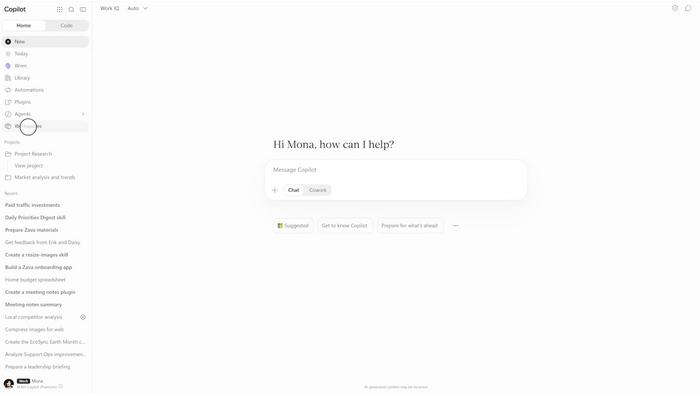
"Copilot Workspaces" bundle documents, conversations, and tasks into a shared space. Team members can work together on documents and track changes as well as remaining tasks. Eventually, AI agents could intervene directly in these spaces, Microsoft notes, although this capability is not yet available.
Integration of Word, Excel, and PowerPoint into Copilot is now accessible to users with eligible licenses. Teams can create and edit documents together directly within the application, without switching between Office apps.
Autopilot, announced in September, is designed as an autonomous agent capable of following projects and executing tasks over extended periods. It can monitor Teams channels, track emails, or coordinate project tasks without new instructions at each step. Each agent has its own identity in Microsoft Entra and a designated owner. IT administrators can track its activities, limit its permissions, and block access to resources if needed.
Microsoft also announced "Microsoft IQ," a platform to structure and make available to AI agents the company's knowledge from different sources. A new connection to Salesforce, in public preview, allows direct exploitation of customer data and commercial features from that platform within Copilot.
What actually changes for a Swiss SME
Who is affected? SMEs already equipped with Microsoft 365 with eligible Copilot licenses, with monitored IT infrastructure — typically with an external provider or a part-time internal manager. Who is not? Organizations without a dedicated IT administrator, those using Microsoft alternatives, or those whose processes still rely heavily on paper and phone.
The potential gain lies in reducing back-and-forth: fewer lost document versions, fewer meetings to check who did what. For a ten-person team managing multiple projects simultaneously, this could represent a few recoverable hours per week. But this is not automatic: someone must define who creates spaces, what naming rules apply, how to archive.
| SME profile | Potential benefit | Likely obstacle |
|---|---|---|
| Fiduciary / accounting firm of 15 people, multiple clients | Centralized client file tracking | Training staff on new workflows |
| Family hotel of 25 rooms | Task coordination between reception and housekeeping | Few eligible licenses, rotating staff |
| Medical or paramedical practice | Shared documentation of protocols | Confidentiality constraints, Swiss nFADP (nLPD) |
| Carpentry of 8 employees, custom projects | Quote and order tracking with workshop | Administration time already saturated |
Hypothetical scenario: a property management firm in Sion
Imagine a property manager with 12 employees overseeing 80 apartments and commercial spaces in Sion and surrounding areas. They already use Microsoft 365 for email and shared calendars. With Copilot Workspaces, they could create one space per building or per dispute file.
Typical case: water damage in a downtown building. Today, the employee logs the call, emails the caretaker, follows up with the plumber via WhatsApp, and hunts for the insurance contract in a poorly organized network folder. Tomorrow, with a Workspace: the employee creates a dedicated space, invites the caretaker and plumber (if external licenses are possible), shares the damage report and insurance contract, and tracks remaining tasks. Autopilot, once available, could monitor the property manager's Teams channel and automatically follow up with the plumber if no response is received within 24 hours.
The catch: the plumber probably has no Microsoft license. The firm must therefore either assign one (cost) or maintain a parallel channel (WhatsApp, phone), which breaks the promised unification. Moreover, the IT manager — often the owner themselves or a half-time employee — must configure access rights, verify that tenant data does not circulate outside the intended space, and train the team.
Points of caution
Data hosting and the Swiss nFADP (nLPD). Microsoft IQ centralizes company knowledge for AI agents. For a Swiss SME, this means more business data transits through the American group's infrastructure. The nFADP requires appropriate guarantees for personal data. Before activating these features, it is prudent to verify the state of contractual clauses with Microsoft and, if necessary, consult a specialist or the FDPIC (PFPDT).
Hidden costs. The announcements concern features in testing or gradual deployment. Their general availability will likely come with license evolution. An SME building its processes on Autopilot today exposes itself to commercial dependency: pricing changes, feature removal, or obligation to upgrade to a higher tier.
Maturity and supervision. Autopilot acts over extended periods without intermediate instruction. Yet the tasks of a Swiss SME are often unpredictable: a tenant changes their mind, a supplier is down, a cantonal regulation evolves. A poorly configured autonomous agent can send inappropriate follow-ups, or worse, modify data without human validation. The "designated owner" mentioned by Microsoft is not a luxury: it is an operational necessity.
Third-party integration. The Salesforce connection illustrates Microsoft's strategy: absorb data from business applications into its ecosystem. For an SME already using Salesforce, this is an opportunity. For one hesitating, it is additional lock-in. The question is not technical: is it desirable to concentrate so many functions with a single provider?
What to do now
- Audit your current Copilot usage. How many active licenses? Which employees actually use them? What measurable gains in time or quality? If the answer is unclear, expanding features is premature.
- Identify a simple pilot case. One recurring process, involving few external actors, where document collaboration is problematic today. Test Workspaces on this case if licenses permit, or in simulation.
- Verify your contractual clauses and processing register. Before Microsoft IQ centralizes more data, confirm where information resides, who accesses it, and whether your register reflects reality. In doubt, the FDPIC (PFPDT) or a specialized advisor can guide you.
- Train an internal reference person. Even part-time, someone must understand Autopilot agent rights, know how to block them, and communicate with your IT provider. This is not optional.
- Evaluate without urgency. These features are in testing or gradual deployment. A Swiss SME has time to observe, discuss with peers, and decide informedly. FlowBiz.ai supports Swiss SMEs in this reflection with a diagnostic of their processes and tailored automations, hosted in Switzerland and deployed in stages.
To learn more about our approach or discuss your specific situation, contact us or discover who we are. We are based in Sion and work primarily with SMEs from Valais and French-speaking Switzerland.