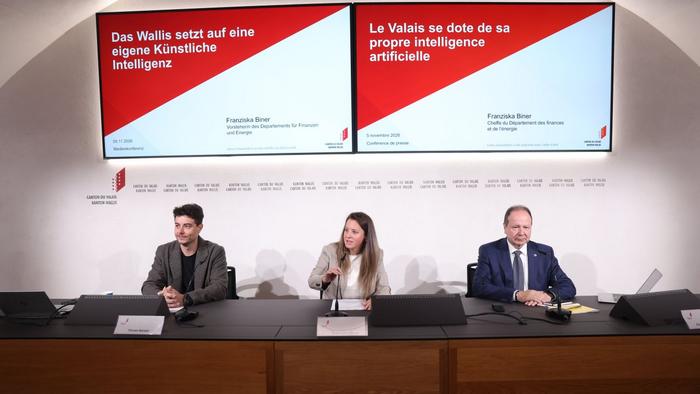
The Canton of Valais has announced the rollout of AVA, an artificial intelligence platform developed in-house and already used by over 2,000 staff. According to ICTjournal, this initiative relies on open-source language models and infrastructure fully controlled by the canton.
For a Romandy SME leader, this development warrants attention. It demonstrates that a mid-sized organisation can deploy AI without depending on Microsoft, Google, or OpenAI. It also raises the question of where business data is hosted—a sensitive issue since the Swiss nFADP (nLPD) entered into force.
What the Canton of Valais Has Built
AVA, short for Assistant Valaisan Augmenté, is developed by the AI Unit of the Cantonal IT Service. The project began in April 2026 and went live six months later. The platform features more than 50 specialised tools and agents.
Technically, AVA combines several open models—notably Apertus, Mistral, and Qwen—with a RAG (retrieval-augmented generation) architecture. This enables querying of internal document bases. Inference runs on dedicated GPUs located in Switzerland. Databases sit on cantonal servers.
The canton estimates the cost at 2 CHF per month per daily active user. It calculates this as at least twenty times cheaper than a comparable commercial solution. The modular architecture allows dedicated assistants: AVA HR, AVA Legal, AVA Parliament. A chatbot for the Traffic and Navigation Service is planned. A gradual opening to municipalities is also under consideration.
The press release specifies two safeguards: no individual decision is automated, and all responses remain subject to human verification. The canton intends to publish the architecture as open source.
What This Means in Practice for a Romandy SME
This initiative shows that sovereign AI is no longer reserved for large federal administrations or banks. An organisation of a few dozen people can now consider models hosted in Switzerland at a controlled cost.
Who should take note: SMEs handling sensitive data—medical practices, accounting firms, property management companies, law firms, architects. Those hesitant to send their documents to American cloud providers. Those seeking to demonstrate local data processing to their clients.
Who need not rush: businesses with limited document volumes, those already using Microsoft 365 without particular regulatory constraints, or those prioritising speed of deployment over sovereignty. AVA remains an administrative model; its direct transfer to a commercial SME is not guaranteed.
A Hypothetical Scenario: The Monthey Accounting Firm
Imagine a ten-person accounting firm in Monthey. It manages financial statements, VAT declarations at 8.1%, payroll with AVS deductions. Staff spend hours searching tax precedents or drafting standardised client responses.
With an architecture inspired by AVA, this firm could:
- Index its own tax document bases on Swiss servers
- Query these bases using natural language questions, without sending data to a foreign provider
- Generate draft responses, always reviewed by a staff member before sending
- Offer a specialist assistant per domain: VAT, company law, remuneration
The hypothetical gain: several hours per week on document research, plus a differentiated commercial position for clients concerned about confidentiality.
Points to Consider Before Getting Started
nFADP (nLPD) and hosting. The Valais initiative confirms that Swiss hosting is technically feasible. For your SME, this does not replace an analysis of your own data processing. The Swiss nFADP (nLPD) imposes obligations according to data sensitivity; a specialist or the Federal Data Protection and Information Commissioner (FDPIC) can guide you.
Real costs. The 2 CHF cited by the canton covers internal use of existing infrastructure. An SME should budget for: servers, maintenance, technical expertise, model updates. The "twenty times cheaper" claim does not automatically apply to a structure without a dedicated IT department.
Maturity of open models. Mistral and Qwen are improving rapidly. They still lag behind the most advanced proprietary models on certain complex tasks. Human verification, as required by the canton, is non-negotiable.
Vendor dependency. Even with open models, you depend on an ecosystem (hardware, frameworks, weight updates). Choosing a sovereign solution reduces one risk but creates others: shortage of local skills, technical obsolescence.
What to Do Now
- Take stock of your data. What documents circulate? Where are they stored? What contracts do you have with existing cloud providers? This is the foundation of any assessment.
- Test an AI assistant on public data. Before indexing your financial statements, familiarise yourself with response quality. Our 2-minute AI quiz helps you evaluate your maturity.
- Compare Swiss and foreign hosting. For which tools does location genuinely matter? Our selection assistant offers a free preliminary diagnosis.
- Evaluate open models on a concrete case. A contract summary, a standard client response. Measure quality and the review time required.
- Speak to an nFADP (nLPD) specialist if you handle sensitive data. Compliance is not improvised. We are in Sion to discuss your specific constraints.
FlowBiz.ai designs assistants and automations hosted in Switzerland for Romandy SMEs. Our team works in small, fixed-price deliverables, with no multi-year commitment. See our automation examples or our services in Valais.