Microsoft is restructuring its Copilot assistant around three pillars — Home, Code, and Autopilot — and extending its capabilities far beyond conversational responses. According to ICTjournal, the vendor is adding natural language app creation, long-form task delegation, and agents that continue working without fresh instructions.
For a Swiss Romandy SME leader already on Microsoft 365, this announcement warrants attention. Your employees could soon build their own internal tools, hand cases over to a persistent agent — and drive up costs without even noticing. Here's what to understand before giving the green light.
What Microsoft is announcing specifically
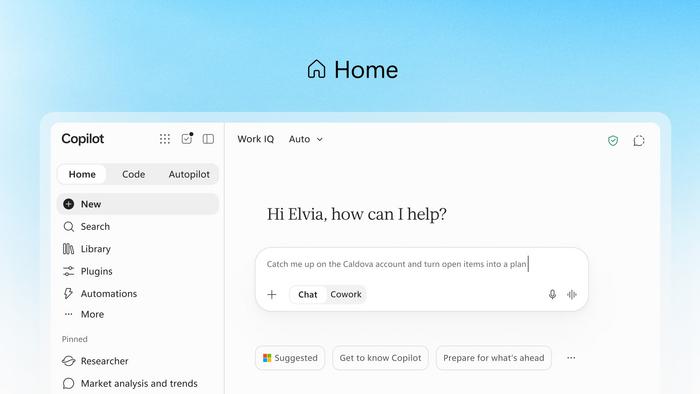
Home becomes Copilot's single entry point. It brings together Chat for ad-hoc queries and Cowork for longer tasks, such as preparing a tender response or compiling a client file. Word, Excel, and PowerPoint integrate directly: a user can request document creation or modification, with sync back to the Office applications.
Code opens app creation to non-developers. A natural language description is enough to generate an internal application, dashboard, tracking tool, or workflow. The code runs in an isolated environment and can be hosted within the company's tenant. Microsoft notes that Copilot Managed Runtime, in preview, allows this code to execute under IT control within the Microsoft 365 environment.
Autopilot, previously called Scout, takes the form of a persistent agent. The user assigns it a name, role, and objective. It monitors channels, tracks conversations, executes recurring tasks, or resumes a project days later without waiting for new instructions. It has its own identity, memory, and workspace within the tenant, with Microsoft 365's permission and audit mechanisms.
Microsoft also clarifies billing: everyday usage remains covered by the fixed license, but Cowork, Code, and Autopilot move to usage-based billing. The vendor is adding FinOps functions to govern these costs — spend policies, credit requests, and control over accessible models.
What changes for a Swiss Romandy SME
| Situation | What becomes possible | What needs attention |
|---|---|---|
| 12-person accounting firm in Martigny | An employee creates a VAT deadline tracking dashboard for clients in a few sentences | What data does the generated app access? Who validates the code? |
| 25-room family hotel in Crans-Montana | An Autopilot agent tracks group inquiries in Outlook and prepares stay proposals | Usage-based billing can vary sharply with the season |
| 8-employee carpentry in Sierre | The manager generates a quote approval workflow without calling a developer | Who handles maintenance and bug fixes? |
SMEs already on Microsoft 365 are affected first. Those outside this ecosystem are not directly impacted, but pressure to standardise may increase.
Code's promise is seductive: no developer needed for a simple internal tool. The reality is more nuanced. A generated app often works for one specific case. Evolving it, debugging failures, integrating with other systems — this still demands technical skills. The risk: an SME ends up with a dozen disposable apps, built by enthusiastic employees, that no one can maintain.
Hypothetical scenario: a property management company in Sion
Imagine a 15-employee firm managing 400 apartments in Central Valais. It already uses Microsoft 365 for email, calendar, and documents.
With Cowork, the lease administrator could hand Copilot the preparation of a renewal file: gather the current contract, correspondence history, applicable indexations, and produce a draft letter. Work that currently takes her about ninety minutes per file could shrink to twenty minutes of verification.
With Code, the technical manager could describe in natural language: "An app listing heating maintenance calls by building, with scheduled date and status." The tool appears in minutes, hosted in the tenant. But if the building changes name, if a heating technician needs mobile access, if data must export to the accounting firm — the limits of no-code surface quickly.
With Autopilot, an agent could monitor the repair request inbox, classify by urgency, open tickets, and chase contractors. It would work through weekends and evenings. But a misclassified water leak, a contractor not chased in time, and liability falls on the company — not Microsoft.
Watch points for a Swiss Romandy SME
nFADP (nLPD) and data hosting
Microsoft states that code can be hosted within the company tenant and that Copilot Managed Runtime executes within the Microsoft 365 environment. This is positive for governance. What remains is to verify precisely where Autopilot agent data resides, what data passes through the models, and whether the default configuration meets the requirements of the new Federal Act on Data Protection (the Swiss nFADP, nLPD). For any specific compliance question, it is best to consult the Federal Data Protection and Information Commissioner (FDPIC) or a specialist.
Costs and usage-based billing
The shift to usage-based billing for Cowork, Code, and Autopilot changes the equation. A fixed license, you budget once a year. Variable consumption can spike without warning. Picture an employee launching an Autopilot agent on a very active channel, or generating apps in loops to test. Microsoft is adding FinOps functions, but their effectiveness in an SME without dedicated IT administration remains to be proven.
Maturity and lock-in
Home and Code are beginning rollout through the Frontier programme. Autopilot is expanding its private preview. These features are therefore not yet mature for critical production use. Moreover, the more apps and workflows an SME builds in the Microsoft ecosystem, the more locked in it becomes. Migrating elsewhere then costs dearly in time and data.
What AI still does poorly
Persistent agents give the illusion of total autonomy. In practice, they still misread context, misinterpret ambiguous instructions, or produce plausibly false results. Human oversight remains essential — which reduces the real time savings.
What to do now
- Wait for field feedback. Do not deploy Cowork, Code, or Autopilot on critical processes as soon as they become available. Let large enterprises and early adopters test robustness. Follow forums and feedback from the Romandy community.
- Audit your Microsoft 365 access and permissions. Before an Autopilot agent can read channels or emails, check who has access to what. An agent inherits its creator's rights. Lax permissions become data breaches.
- Establish a provisional internal policy. Even before tools mature, decide who can create apps, within what framework, with whose validation. This prevents drift when the feature becomes available.
- Set a consumption ceiling. As soon as FinOps functions reach your tenant, configure alerts and limits. Treat usage-based billing like a phone abroad: without a cap, surprises come fast.
- Test the selection assistant from FlowBiz.ai. We guide Romandy SMEs to identify, step by step, where AI and automation deliver real gains — without excessive dependency or excessive promises. Our solutions are hosted in Switzerland, with support in Swiss French. You can also browse our automation examples or take our 2-minute AI quiz to assess your maturity.
Microsoft's promise is clear: AI that works alone, creates tools, and delegates repetitive tasks. For a Swiss Romandy SME, the opportunity is real, but so are the brakes. Prudence means preparing the organisation before adopting the technology.