
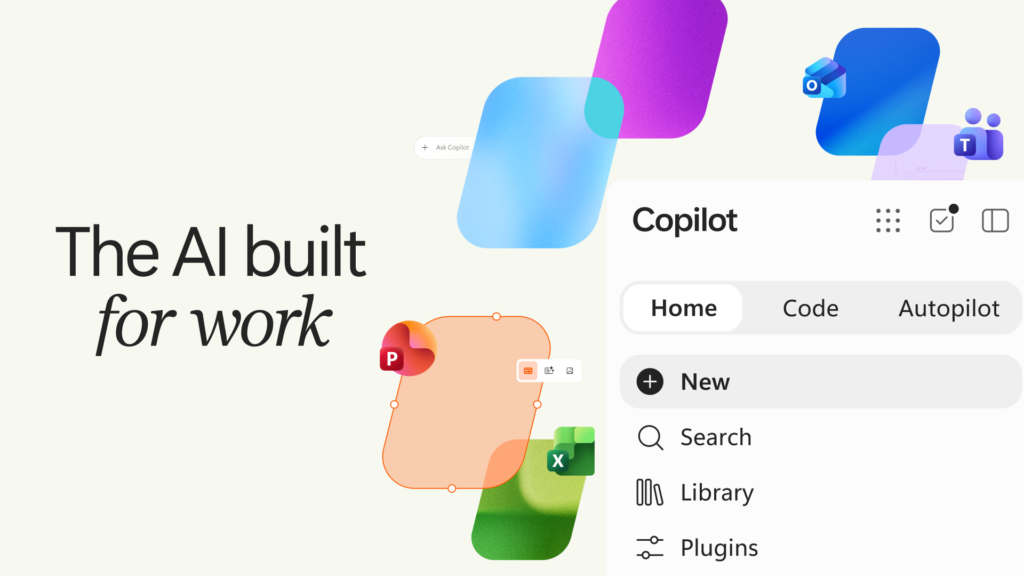
Microsoft announced a complete overhaul of Copilot around three capabilities: Home, Code, and Autopilot. Home brings together chat and task delegation, Code lets you build business solutions in natural language, and Autopilot is an agent that works in the background without constant prompting.
For a Swiss SME owner, the challenge isn't technical. It's organizational: how to structure AI across the company without every employee jury-rigging their own tool, without dispersing customer data, without the bill becoming opaque. This announcement lays the groundwork for an answer — with caveats to understand.
What Microsoft is announcing specifically
Home is the unified starting point. Chat handles quick questions. Cowork executes complex end-to-end tasks: responding to a tender, preparing a year-end closing package, drafting a client brief. Microsoft is also integrating Word, Excel, and PowerPoint directly into the experience, with no app switching.
Code lets you describe an application, dashboard, or automation in natural language. Copilot builds the solution, which runs in an isolated environment hosted within the company's tenant. Developers keep GitHub Copilot for their daily work.
Autopilot, formerly Scout, is a named and configured agent that monitors channels, follows up with contacts, manages recurring processes, and resumes projects after several days. It has its own identity, memory, and workspace within the tenant.
Microsoft is also introducing Usage-Based Billing for Cowork, Code, Autopilot, and advanced models, supplementing the existing fixed subscription. A FinOps for AI tool is announced to track these expenses.
What this means for a Swiss SME
Who is affected: SMEs already on Microsoft 365, especially those with repetitive processes (quotes, reports, follow-ups, project tracking). A fiduciary / accounting firm in Martigny could delegate the preparation of closing packages. A property management company in Sion could automate lease tracking and rent reviews. An engineering firm could create construction site dashboards without hiring a developer.
Who isn't (yet): Companies on Google Workspace or open-source tools, which would need to migrate. SMEs without an IT administrator, because governing plugins, agents, and permissions requires oversight. Organizations highly sensitive to response times, because agentic capabilities are still in preview and their reliability remains to be proven.
| Mode | Typical SME use | Billing |
|---|---|---|
| Chat (Home) | Quick answers, email drafts, summaries | Fixed subscription |
| Cowork (Home) | Complete packages, tender responses | Pay-per-use |
| Code | Internal applications, business automations | Pay-per-use |
| Autopilot | Follow-ups, process tracking over several days | Pay-per-use |
Hypothetical scenario: a carpentry business in Sierre
Imagine a fifteen-person carpentry firm working in new construction and renovation. The sales manager spends several hours each week preparing quotes, following up with architects, and tracking ongoing orders.
With Copilot Home, they request a draft tender response from a PDF specification. Cowork structures the document, inserts references to similar projects from shared files, and produces a formatted proposal. Time saved on this task would be measured in hours, hypothetically.
With Code, they describe an order tracking dashboard: status, lead time, supplier, scheduled installation date. Copilot generates the application, hosted in the tenant. The worker on site checks status from their phone. No external developer, no additional SaaS subscription.
With Autopilot, they configure a "Site Tracking" agent that automatically follows up with late suppliers, alerts when a delivery delay threatens an installation date, and summarizes the situation to the team every Monday morning. The agent works over the weekend, without intervention.
The risk: usage-based billing. If the agent sends twenty follow-ups daily, analyzes dozens of documents, and uses advanced models, the monthly cost becomes unpredictable. Without monitoring, time savings turn into budget overruns.
Points of caution
Swiss nFADP (nLPD) and hosting. Data processed by Home, Code, and Autopilot stays within the company's Microsoft 365 tenant. This is positive for governance. However, the physical storage location, involved subcontractors, and contractual guarantees must be verified. For particularly sensitive data, refer to the Federal Data Protection and Information Commissioner (FDPIC) or a specialized advisor.
Hidden costs. The fixed subscription covers simple uses. Agentic capabilities shift to consumption-based pricing. Microsoft is announcing FinOps tools, but the discipline of tracking spending falls to the company. An SME deploying Autopilot without caps takes a financial risk.
Maturity. Home and Code are arriving in a Frontier program in the coming weeks. Autopilot remains in private preview. The reliability of these tools in specific business contexts — a QR-bill misinterpreted, a follow-up sent to the wrong contact — is not guaranteed. It is better to test on non-critical processes.
Vendor lock-in. The more an SME builds applications in Copilot Code, the more it locks into the Microsoft ecosystem. Migrating a dozen mini business applications to another platform would represent considerable work. This is a strategic choice, not merely a technical one.
What to do now
- Inventory your repetitive processes. Which tasks consume an hour or more of predictable work each week? These are the first candidates for Cowork or Autopilot. See automation examples.
- Audit your Microsoft 365 tenant. Check who has access to what, where your data is stored, and whether your governance settings will allow you to control agents and plugins. Without this foundation, Autopilot is a risk.
- Test on a limited case. One process, two or three users, four to six weeks. Measure time saved and bill generated before expanding. Take the 2-minute AI quiz to assess your maturity.
- Prepare an internal usage policy. Who can create agents? What data can they access? What spending cap? These rules prevent drift.
- Evaluate alternatives. Copilot is not the only path. Depending on your needs, Swiss-hosted solutions, lighter automations, or specialized assistants may be relevant. Discover our AI solutions for SMEs: selection assistant and free pre-diagnosis.
FlowBiz.ai supports French-speaking Swiss SMEs from Sion in selecting and deploying AI assistants, agents, and automations, in Sion and Valais. Swiss hosting, phased delivery, fixed pricing. Contact us or learn who we are.